

Executive Summary: While much of the world still associates "vending machines" with clunky, coin-operated snack dispensers, China has quietly built the world's largest AI-powered unattended retail ecosystem. The recent IPO filing from Fengyi Technology Group (丰e足食) — China's #1 AI vending machine operator — reveals a business that is not only technologically mature but profitable on an adjusted basis at massive scale. This article examines the industry through Fengyi's prospectus, unpacking the technology, economics, and market data that make AI vending machines (Grab & Go machines) one of the most underappreciated infrastructure plays in global retail.
1. The $2.8 Billion Market Most People Haven't Heard Of
When Amazon launched its first Amazon Go store in 2018, the "just walk out" concept captured global imagination. But while Amazon was experimenting with full-size cashierless grocery stores — an approach that has since been scaled back — a parallel revolution was unfolding across the Pacific.
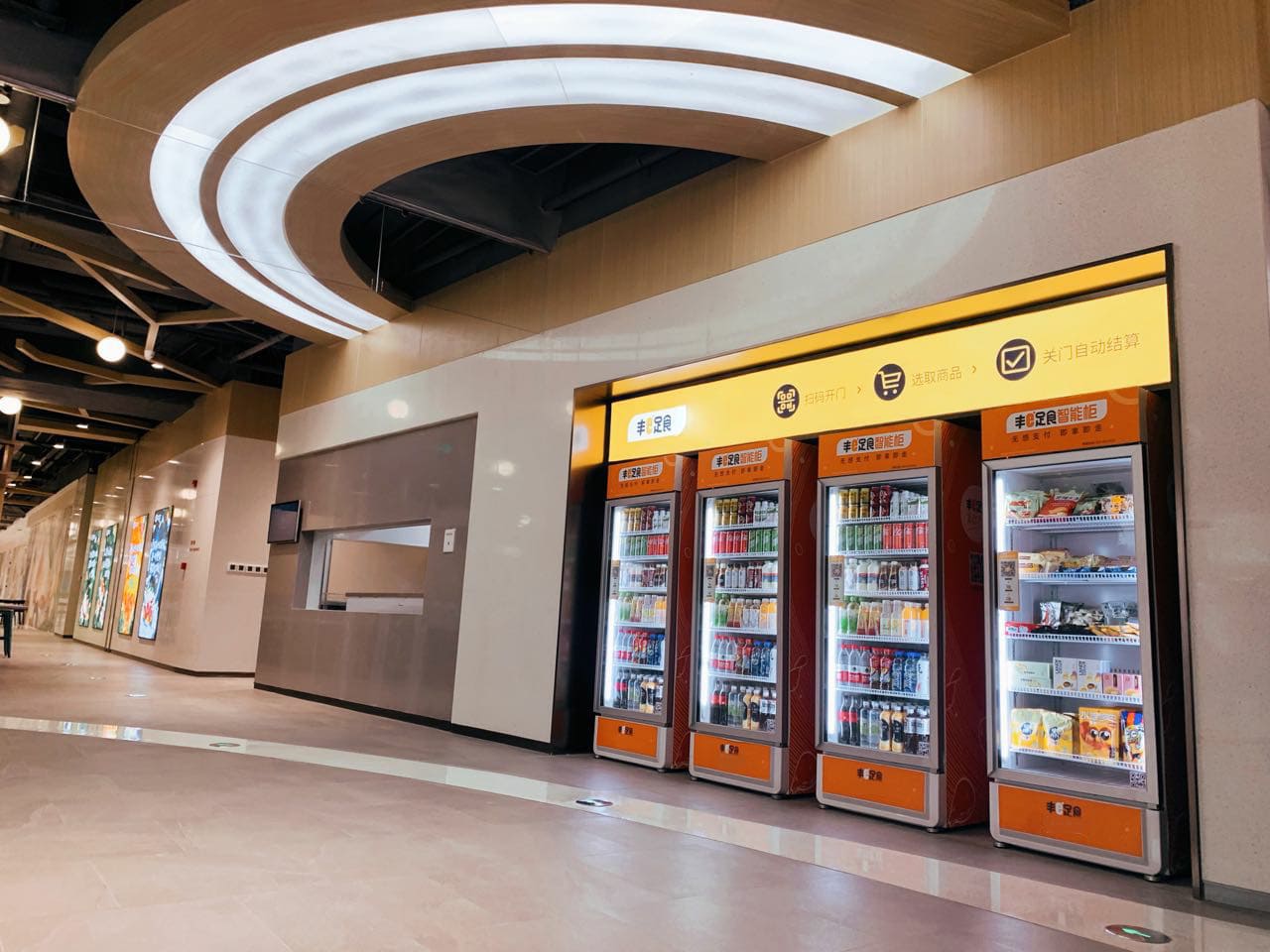
In China, a different form factor has won: the AI vending machine (智能售货机 / 开门柜) — essentially a compact, AI-powered cooler that lets consumers scan a QR code, open the door, grab what they want, and walk away, with payment processed automatically. Think of it as an Amazon Go condensed into a single refrigerator-sized unit, deployed at roughly 30% the cost of a traditional vending machine.
According to Frost & Sullivan (cited in Fengyi's IPO prospectus), China's AI vending machine market has grown from 91,400 units in 2021 to 855,300 units in 2025 — a compound annual growth rate (CAGR) of 74.9%. In GMV terms, the market expanded from RMB 2.0 billion to RMB 20.3 billion (≈ $2.8B) over the same period. By 2030, the installed base is projected to reach 3.5 million units, with AI vending machines accounting for 95.2% of all vending machines in China.
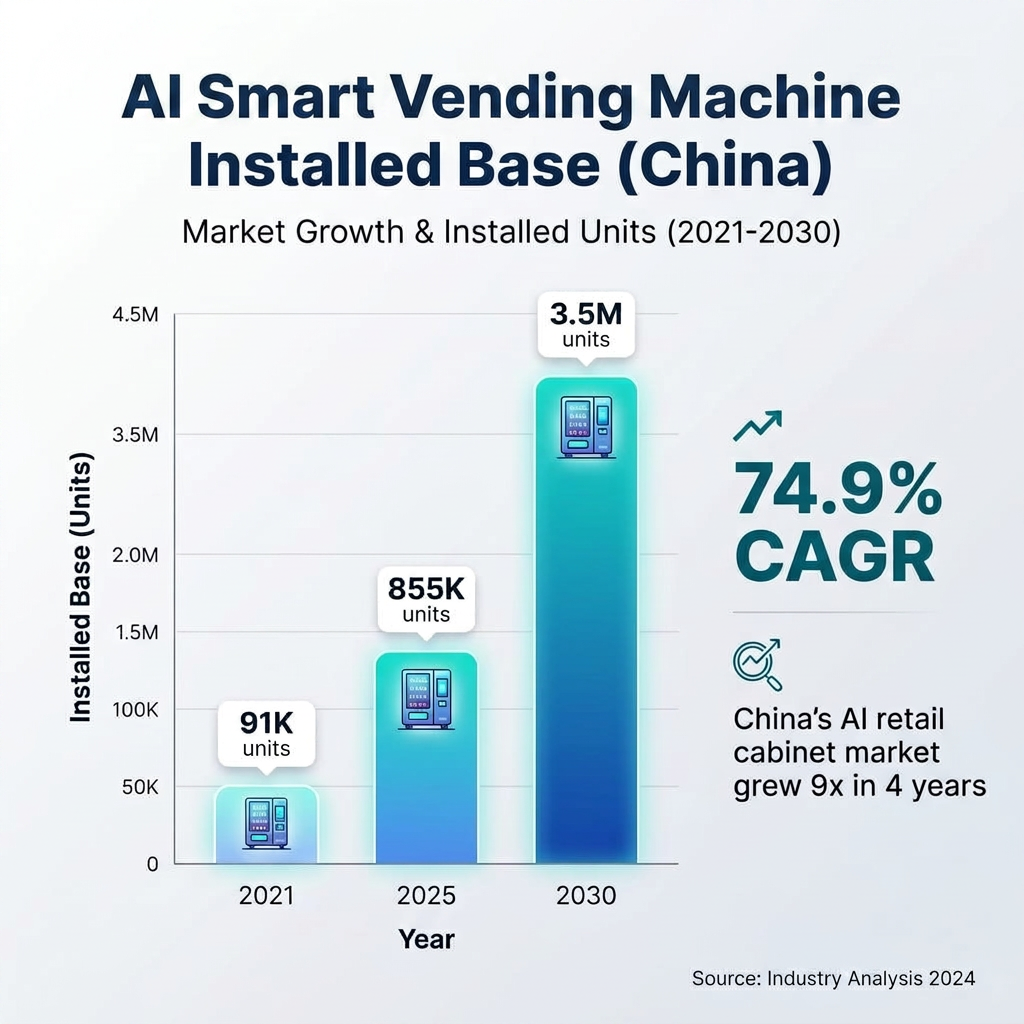
- Installed Base (thousands) — 2021: 91.4 · 2025: 855.3 · 2030E: 3,506.6
- GMV (RMB billions) — 2021: 2.0 · 2025: 20.3 · 2030E: 68.9
- Light-Traffic Share of Units — 2021: 44.6% · 2025: 49.6% · 2030E: 65.5%
This is not a speculative future. This is already happening.
2. Meet Fengyi: China's AI Vending Machine Leader
In June 2026, Shenzhen Fengyi Technology Group Co., Ltd. (深圳市丰宜科技集团股份有限公司) filed for an IPO on the Hong Kong Stock Exchange. The prospectus provides an unprecedented look into the economics of AI-powered unattended retail at scale.
By the Numbers
- 183,989 AI vending machines deployed across 72 Chinese cities as of December 31, 2025
- #1 in China by both installed base (21.5% market share) and GMV (11.5% market share)
- 80 million+ cumulative consumers served
- RMB 2.34 billion (≈$320M USD) in GMV for 2025
- RMB 2.01 billion (≈$275M USD) in revenue for 2025, with a 27.1% CAGR from 2023
- 55.8% gross profit margin in 2025, up from 52.4% in 2023
- RMB 118.6 million (≈$16.2M USD) in adjusted net profit (non-IFRS) in 2025
- Positive operating cash flow in every period tracked
These are not the numbers of an early-stage experiment. This is a scaled business with improving unit economics year over year.
Balance note (keep for an overseas readership): The profit figure above is adjusted (non-IFRS). Under IFRS, Fengyi reported a net loss of RMB 37.2M in 2025 and carried net debt of ≈ RMB 336M at year-end. The business is "profitable on an adjusted basis," not yet IFRS-net-profit positive — an important distinction for investors outside China.
Revenue Breakdown
- 2023 — Revenue (RMB millions): 1,243.7 · Gross Margin: 52.4% · Adjusted Net Profit (RMB millions): 101.0
- 2024 — Revenue (RMB millions): 1,652.3 · Gross Margin: 54.0% · Adjusted Net Profit (RMB millions): 77.4
- 2025 — Revenue (RMB millions): 2,008.9 · Gross Margin: 55.8% · Adjusted Net Profit (RMB millions): 118.6
Approximately 99% of revenue comes from product sales through AI vending machines; the remaining ~1% is advertising displayed on AI vending machine screens.
3. The Technology Stack: How It Actually Works
3.1 Hardware: Simple, Cheap, and Purpose-Built
A Fengyi AI vending machine is remarkably simple hardware: an industrial control computer, two commodity cameras, an electronic lock, a 4G communication module, and a QR code / NFC reader. That's it. No complex mechanical dispensing mechanisms. No RFID tags on every product. No weight sensors in every shelf.
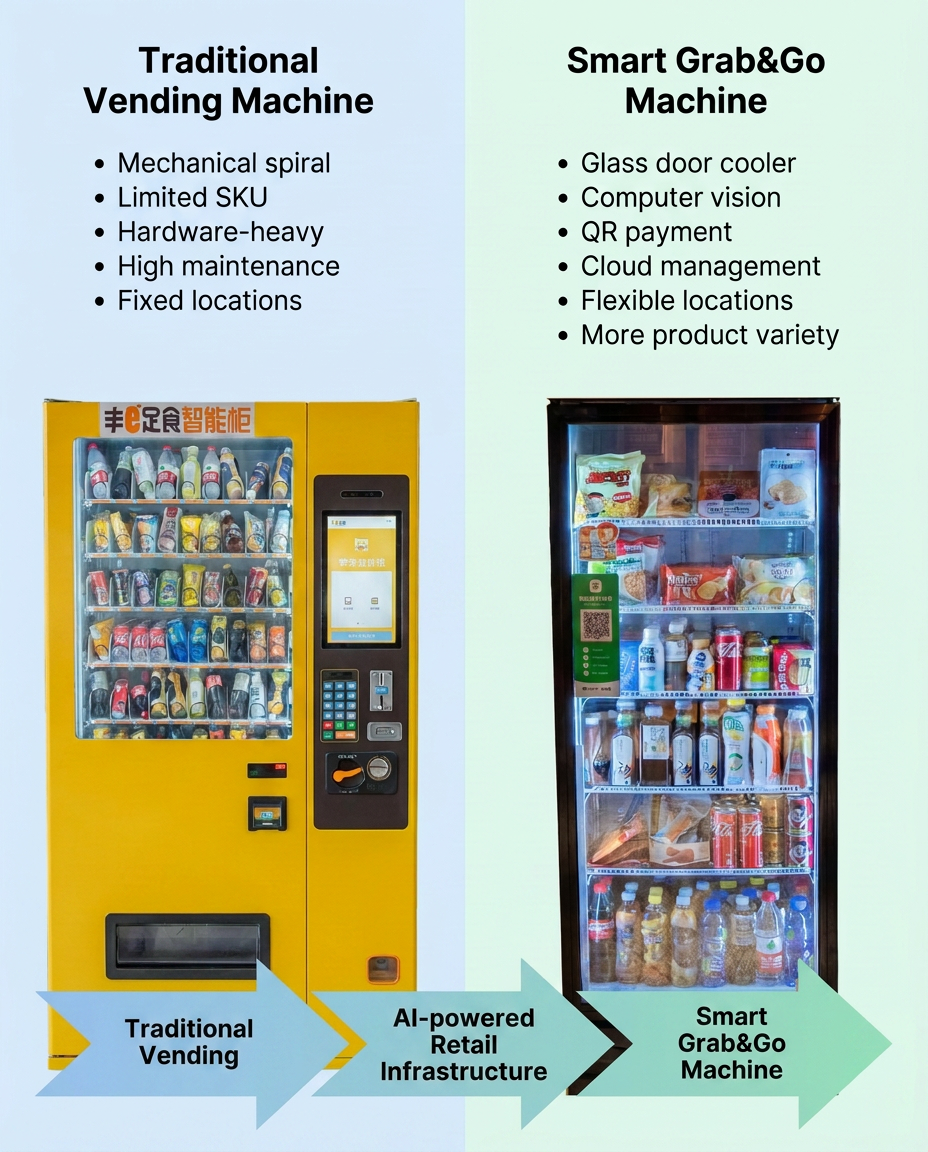
This hardware minimalism is the first competitive moat. Traditional vending machines depend on spring coils, conveyor belts, or robotic arms — all of which jam, require maintenance, and limit product variety. By moving the complexity from hardware to software, Fengyi cut the hardware cost to ~30% of a traditional machine, while simultaneously enabling a dramatically better user experience.
3.2 Computer Vision: The Real Competitive Moat
When a consumer opens the AI vending machine door, the dual cameras capture localized video clips of the item selection process. This footage is uploaded via 4G to the cloud, where the recognition system processes it through a multi-tiered pipeline:
- Basic Behavior Recognition: Hand action classification (pick vs. place), product identification via proprietary computer vision models
- Scene Understanding Router: Determines complexity — is this a clear single-item pickup, or a cluttered multi-item scenario?
- Model Selection:
- Simple cases → Self-developed efficiency engine (CV detection pipeline) for speed
- Complex cases (product occlusion, stacking, ambiguous movements) → Large multimodal models (VLM reasoning engine) for accuracy
- Decision & Output: Final product identification and order generation
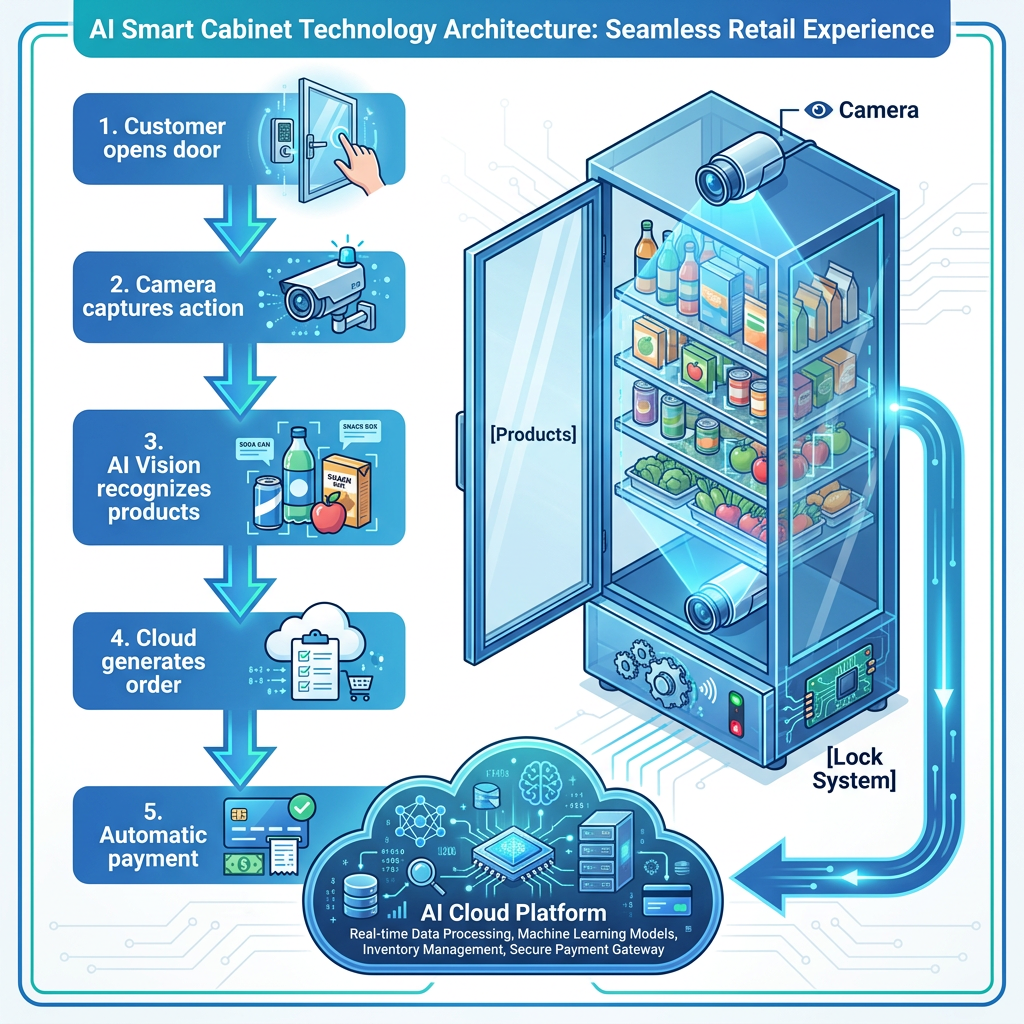
Fengyi reports a customer complaint rate of fewer than 6 incidents per 10,000 orders — roughly 99.94% accuracy. This has been achieved through training on hundreds of millions of anonymized order records over 8+ years of continuous operation.
3.3 The FLOW Pilot Agent System: Autonomous Operations at Scale
The real breakthrough is not in individual AI vending machine recognition but in the algorithmic operating system that manages the entire network. Fengyi's proprietary FLOW Pilot system consists of four interconnected AI agents:
- Field Pilot — Function: Site expansion: lead recommendation, risk assessment, expansion strategy
- Link Pilot — Function: Product assortment: demand sensing, SKU optimization per AI vending machine · Daily Decisions (Q4 2025): ~48 million
- Opti Pilot — Function: Inventory & supply chain: dynamic allocation, stocking decisions, transshipment
- Work Pilot — Function: Fulfillment: route planning, driver dispatching, task verification
Combined, FLOW Pilot makes nearly 120 million decisions per day. In Q4 2025, only approximately 20,000 of those decisions required human intervention — an automation rate exceeding 99.98%.
The result: the average number of AI vending machines managed per operational staff member increased from 303 in 2023 to 504 in 2025 — a 66% improvement in two years.
4. The Business Model: Why "Light-Traffic" Is the Secret
4.1 Two Markets, One Winner
Fengyi's strategic insight was to distinguish between two fundamentally different deployment scenarios:
- Typical locations — High-Traffic Scenarios: Transportation hubs, tourist spots, core business districts · Light-Traffic Scenarios: Offices, small gyms, remote factories, apartment lobbies
- Monthly GMV/AI vending machine — High-Traffic Scenarios: Above RMB 2,000 · Light-Traffic Scenarios: Below RMB 2,000 (Fengyi average: ~RMB 1,200)
- Site acquisition — High-Traffic Scenarios: Resource-intensive, competitive, expensive · Light-Traffic Scenarios: Low-cost, abundant, under-served
- Operational complexity — High-Traffic Scenarios: Low (homogeneous demand, high-frequency replenishment) · Light-Traffic Scenarios: High (diverse demand, needs algorithmic optimization)
- Competitive barrier — High-Traffic Scenarios: Capital & site resources · Light-Traffic Scenarios: Technology & operational efficiency
- Competitors — High-Traffic Scenarios: Brand-owned vending (Coca-Cola, Nongfu Spring, etc.) · Light-Traffic Scenarios: Effectively uncontested
The high-traffic segment is crowded and competitive. Brand owners like Nongfu Spring and Genki Forest deploy their own AI vending machines with narrow, brand-specific SKU ranges.
The light-traffic segment — which Frost & Sullivan estimates will grow from 424,400 units in 2025 to 2,296,700 by 2030 (CAGR of 40.2%) — is where Fengyi operates with minimal competition. The reason: it's extremely hard to be profitable in low-volume locations without algorithmic optimization.
4.2 The Economics of Small Sites
Fengyi's average monthly sales per AI vending machine are approximately RMB 1,200 (~$164 USD). But the breakeven point is as low as RMB 300 per month — roughly one transaction per day. How?
- Low hardware cost (30% of traditional machines)
- Low site cost (Fengyi is often the sole operator; site partners rarely charge premium rents for SME locations)
- Algorithmic supply chain efficiency — the distributed network model reduces logistics cost per unit
- Shrinkage controlled at ~1%, versus an industry average of ~5%
- Each operator manages ~115 AI vending machines (2x industry average), keeping labor costs low
This fundamentally changes the addressable market. A traditional vending operator needs each machine to generate high volume to justify the hardware investment. Fengyi can profitably serve locations that competitors physically cannot reach.
4.3 The Distributed Network: Beyond One-Way Supply Chains
Traditional retail uses a unidirectional supply chain: warehouse → store → consumer. Fengyi's network is multi-directional. Each AI vending machine serves simultaneously as:
- A point of sale
- A data collection node
- A temporary storage unit
- A product transfer point
In 2025, 22% of total sales in light-traffic scenarios came from inventory cleared through inter-machine transshipment. For every 100 AI vending machines visited for replenishment, the algorithm assigns an additional 55 transshipment tasks — without generating new delivery routes. Slow-moving products are algorithmically relocated to higher-demand locations, reducing waste and improving turnover.
This is not merely an operational tweak; it's a structural competitive advantage that becomes stronger with network density — a classic flywheel effect.
5. The Product Strategy: Long-Tail at Scale
Fengyi's product strategy contradicts conventional vending wisdom. Rather than stocking only top-selling beverages and snacks, each AI vending machine carries an average of 48.4 SKUs with 7.3 new products introduced monthly. In 2025, 1,480 niche and long-tail products (defined as items with a placement rate below 20%) accounted for 20% of total transactions.
This is enabled entirely by Link Pilot's demand-sensing capabilities. The algorithm analyzes transaction data, regional preferences, product correlations, seasonal patterns, and external factors to determine the optimal assortment for each individual AI vending machine. No human merchandiser could make these decisions at scale.
The strategic benefit is twofold:
- Consumer loyalty: The constantly refreshed "treasure hunt" experience drives repeat visits — average monthly purchase frequency is 3 times per person with a 46.7% repeat purchase rate
- Brand partner value: Fengyi's network becomes a preferred channel for new product testing and launch, which in turn improves procurement terms (gross margins expanded from 52.4% to 55.8% over the tracked period)
6. Global Context: Where Does This Fit?
6.1 The Global Intelligent Vending Machine Market
Multiple research firms project the global intelligent vending machine market to grow from approximately $20–29 billion in 2025 to $50–90 billion by the early 2030s, at CAGRs ranging from 11% to 16%:
- Precedence Research — 2025 Market Size: $29.0B · 2030–2034 Projection: $92.6B (2034) · CAGR: 13.8%
- Grand View Research — 2030–2034 Projection: $55.5B (2030)
- Straits Research — 2025 Market Size: $32.6B · 2030–2034 Projection: $88.7B (2033) · CAGR: 13.3%
- IMARC Group — 2025 Market Size: $19.4B (2024) · 2030–2034 Projection: $54.0B (2033) · CAGR: 11.5%
The Asia-Pacific region dominates, with China alone representing the largest and fastest-growing market. According to industry data, the APAC intelligent vending market was valued at approximately $6.0 billion in 2024 and is projected to grow at 16.1% CAGR to $22.8 billion by 2033.
6.2 The Western Landscape: Fragmented and Early-Stage
- Amazon Just Walk Out targeted full-size grocery stores but has been partially withdrawn from Amazon Fresh locations in the US (April 2024), pivoting to third-party licensing for smaller venues like stadiums, airports, and hospitals. The technology reportedly cost up to $1 million per store to deploy.
- AiFi has raised ~$80M and deployed approximately 115+ autonomous stores globally (Carrefour, Morrisons, Żabka, ALDI), but remains sub-scale relative to Fengyi — a single-digit ARR run rate of ~$12M.
- Standard AI (formerly Standard Cognition) raised $239M but pivoted away from autonomous checkout to computer vision analytics for retailers.
- Grabango, Trigo, and Zippin collectively raised hundreds of millions but have focused on retrofitting existing stores rather than deploying standalone AI vending machine networks.
The key difference: Western approaches have overwhelmingly targeted the high-cost, full-store autonomous checkout problem. The Chinese approach — low-cost, small-footprint AI vending machines in light-traffic scenarios — has proven faster to scale, cheaper to deploy, and more immediately profitable.
6.3 Why the AI Vending Machine Model Wins
- Deployment cost — Full-Store Autonomous (Western): $100K–$1M+ per store · AI Vending Machine (Chinese): ~$500–1,000 per AI vending machine
- Installation time — Full-Store Autonomous (Western): Weeks to months · AI Vending Machine (Chinese): Hours
- SKU range — Full-Store Autonomous (Western): 2,000+ · AI Vending Machine (Chinese): ~48 per AI vending machine
- Site flexibility — Full-Store Autonomous (Western): Fixed, high-traffic only · AI Vending Machine (Chinese): Anywhere with power
- Scalability — Full-Store Autonomous (Western): Low (bespoke per store) · AI Vending Machine (Chinese): High (standardized hardware)
- Path to profitability — Full-Store Autonomous (Western): Require high volume per location · AI Vending Machine (Chinese): Profitable at ~1 transaction/day
- Addressable locations — Full-Store Autonomous (Western): Thousands · AI Vending Machine (Chinese): Millions
The AI vending machine model is not competing with full-store autonomous checkout — it's creating an entirely new category of retail infrastructure. As Fengyi's prospectus notes, these AI vending machines are transitioning from a supplementary channel into an integral layer of offline retail infrastructure.
7. Key Takeaways for Industry Observers
7.1 The Technology Is Mature — Not Experimental
After 8+ years of continuous operation, hundreds of millions of transactions, and algorithmic iteration, the core technology stack is proven:
- Computer vision recognition at 99.94% accuracy
- Autonomous decision-making across 120 million daily operations
- Full-stack IoT management for 180,000+ connected AI vending machines
- Algorithmic supply chain with multi-directional product flow
7.2 The Business Model Is Validated — Not Hypothetical
Fengyi's IPO filing provides audited financial proof:
- Revenue: RMB 2.0 billion (2025), growing at 27% CAGR
- Gross margin expanding (52.4% → 55.8%)
- Adjusted net profit: RMB 118.6 million (2025)
- Unit economics improving (breakeven at RMB 300/month per AI vending machine)
- Positive operating cash flow every period
7.3 The Market Opportunity Is Global
China's AI vending machine installed base grew from 91K to 855K units in four years. The global market for intelligent vending is $25B+ and growing at 13%+ CAGR. If the Chinese adoption curve suggests anything, it's that the transition from traditional vending to AI-powered vending machines is both inevitable and accelerating.
Southeast Asia, in particular, shows strong leading indicators:
- Malaysia: 70% growth in vending machine sales over five years
- Vietnam: 10,000 vending machines (2023), heavily underpenetrated
- Indonesia: 30,000 vending machines (2023) for 280 million people
- Thailand and Singapore: ~10% growth each over five years
These markets mirror China's conditions 5–7 years ago: rising labor costs, rapid urbanization, high smartphone penetration, and strong demand for convenience — but with far fewer legacy vending machines to displace.
7.4 There Is No Western Equivalent at This Scale
No company outside of China operates a directly-managed, AI-powered vending machine network at anything approaching Fengyi's scale. The combination of:
- Low hardware cost (30% of traditional machines)
- Algorithmic operations (FLOW Pilot)
- Directly-operated model (full data and execution control)
- Light-traffic strategic focus (uncontested market)
…has no direct parallel in the US, Europe, or Southeast Asia. This represents a significant first-mover opportunity for companies that can adapt the model to local markets.
8. The Bottom Line
The next time someone mentions "vending machines," it's worth recalibrating the mental image. The AI vending machine is to a traditional vending machine what the smartphone was to a payphone: superficially serving a similar function, but fundamentally a different category of technology — connected, intelligent, data-driven, and capable of reshaping an entire industry.
Fengyi's HKEX filing is more than a corporate milestone. It's public documentation that the AI-powered unattended retail model is real, scalable, and profitable. For anyone building or investing in the future of retail infrastructure — whether in China, Southeast Asia, Europe, or the Americas — the AI vending machine is no longer a question of "if." The only remaining question is "who" and "how fast."
Sources: Fengyi Technology Group IPO Application Proof (HKEX, June 2026); Frost & Sullivan industry analysis (cited in Fengyi prospectus); Precedence Research, Straits Research, IMARC Group, Grand View Research (global intelligent vending machine market reports, 2025); Euromonitor International (Southeast Asia vending data); public reports on AiFi, Amazon Just Walk Out, Standard AI.